
Sculptra vs. Facelift: Which Option Is Right for Facial Rejuvenation?
As we age, changes in the face tend to happen gradually—volume loss, sagging skin, deeper folds, and less collagen. When patients start exploring ways to restore a more youthful appearance, two options often come up: Sculptra injections or a facelift surgery.
Both treatments aim to improve facial aging, but they work in very different ways. One builds collagen gradually with injections, while the other surgically repositions tissues for a more dramatic lift.
This guide breaks down the cost, treatment timeline, downtime, and results of each option so patients can better understand which approach may fit their goals and lifestyle.
What Is Sculptra?
Sculptra is an injectable treatment made from poly-L-lactic acid, a collagen-stimulating compound. Instead of instantly filling wrinkles like traditional dermal fillers, Sculptra works by stimulating your body’s natural collagen production over time.
This gradual collagen rebuilding improves:
Facial volume loss
Hollow temples or cheeks
Skin thinning
Early jowling
Overall skin quality
Unlike fillers that provide immediate volume, Sculptra results appear slowly as collagen rebuilds beneath the skin.
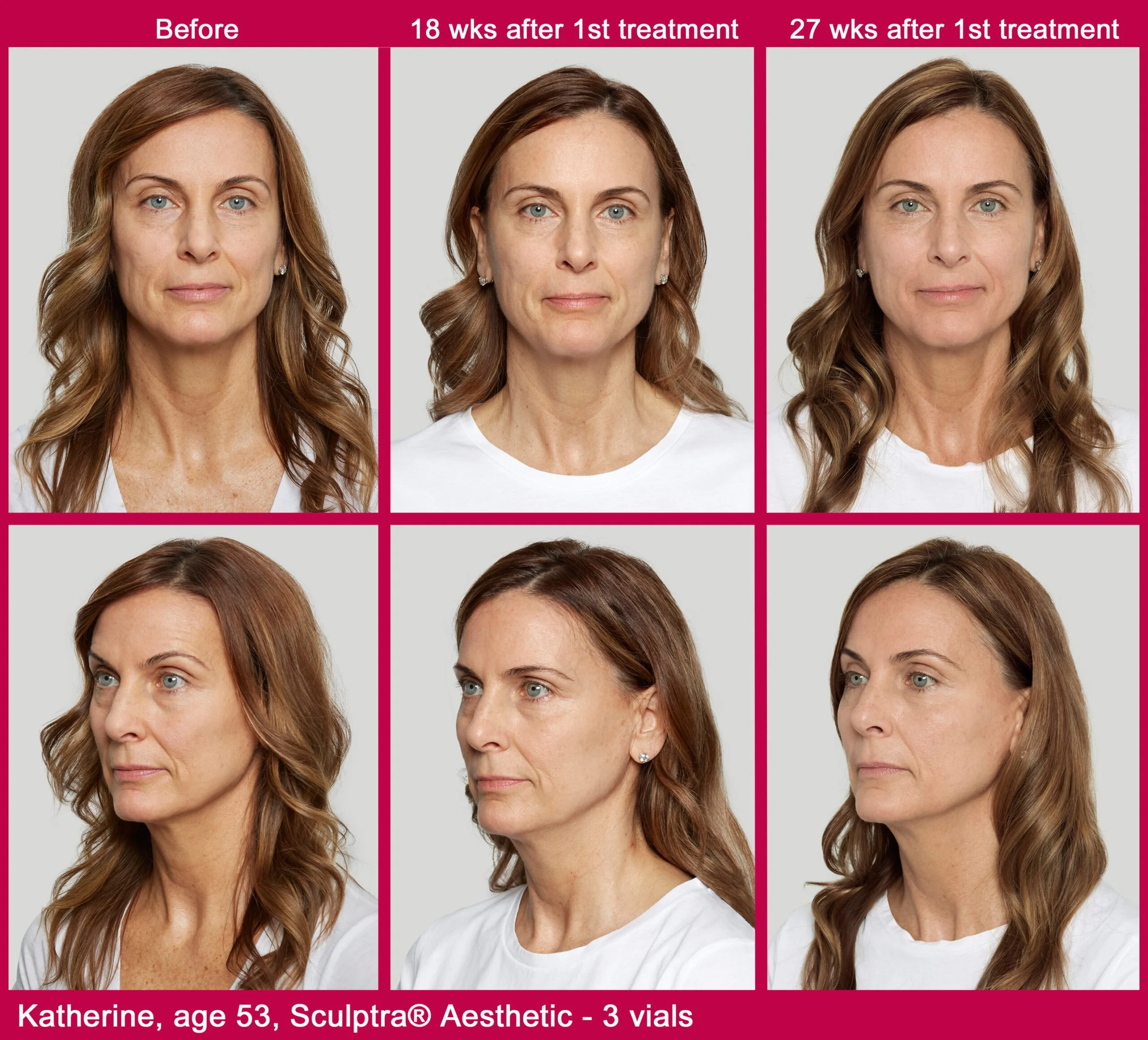
What Does a Typical Sculptra Treatment Plan Look Like?
Step 1: Consultation
During a consultation, your provider evaluates facial volume loss and determines how many vials are needed. A common guideline used by many injectors is: 1 vial per decade of life
Example:
30s → 3 vials
40s → 4 vials
50s → 5 vials
However, this varies widely depending on facial anatomy and treatment goals.
Step 2: Treatment Sessions
Most patients require 2–3 sessions spaced about 4–6 weeks apart.
Each treatment typically takes 20–30 minutes.
Step 3: Collagen Building Phase
Results do not appear immediately.
Typical timeline:
4–6 weeks: early collagen production begins
3 months: noticeable improvement
3–6 months: full results visible
Results can last up to 2 years before maintenance is needed.
Realistic Cost of Sculptra
Sculptra is priced per vial. Typical U.S. pricing ranges from $750 – $1,200 per vial
Pros and Cons of Sculptra
Advantages
Non-surgical
Minimal downtime (often same day)
Natural-looking gradual results
Improves skin thickness and quality
Stimulates your own collagen
Limitations
Results take months to appear
Requires multiple sessions
Does not remove excess skin
Limited lifting ability for advanced sagging
For mild to moderate aging, Sculptra can be a great solution—but it cannot replace surgery when significant sagging is present.
What Is a Facelift?
A facelift is a surgical procedure that repositions facial tissues and removes excess skin to create a more youthful contour.
Unlike injectables that restore volume, a facelift addresses structural sagging of the:
cheeks
jawline
lower face
neck
Modern facelift techniques focus on lifting deeper facial structures rather than simply tightening the skin.
Types of Facelift Procedures
Mini Facelift
Best for early aging changes.
Typical features:
smaller incisions
shorter surgery
faster recovery
Downtime: about 5–10 days
Longevity: 5–8 years
SMAS Facelift
This is the most common traditional facelift.
It lifts the SMAS layer (the deeper muscle support layer of the face).
Downtime: 10–14 days
Longevity: 7–10 years
Deep Plane Facelift
A more advanced surgical technique that repositions deeper facial structures and fat pads.
Benefits:
very natural results
stronger lifting effect
longer lasting results
Downtime: 2–3+ weeks
Longevity: 10–15 years
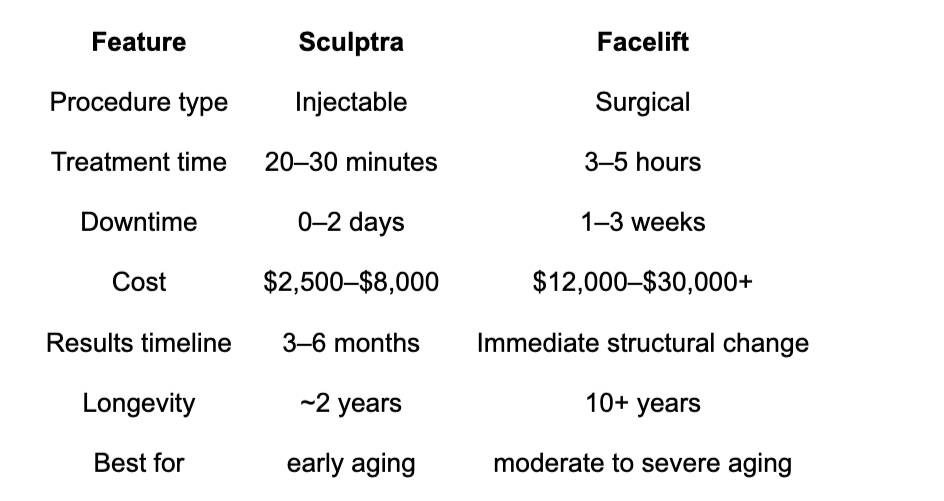
Quick Comparison: Sculptra vs Facelift
Which Option Is Right for You?
Patients often choose Sculptra when they want:
subtle improvement
collagen restoration
minimal downtime
prevention of aging changes
Facelifts are usually better for patients experiencing:
loose skin around the jawline
deep jowls
neck sagging
significant facial descent
A Common Strategy: Combining Both
Many aesthetic specialists now combine treatments:
Late 30s–40s
Sculptra for collagen stimulation
neuromodulators and skin treatments
50s–60s
Facelift for structural lifting
Sculptra to improve skin quality
This strategy allows patients to maintain natural results over time.
Bottom line: Sculptra is an excellent collagen-stimulating treatment for early aging, while a facelift provides a more dramatic and long-lasting solution for advanced sagging. The best option depends on your facial anatomy, goals, and comfort with surgery.