
Why Bespoke Shoemaking Is Dying — and How to Revive It
Bespoke shoes probably aren’t for you. Most people can find ready-to-wear shoes that fit very well and appear nearly as elegant as a handmade pair. Quality, factory-made shoes—like the ones I sell at Old House Provisions—can last a lifetime. I’ll be the first to admit that the often $10,000-or-more price tag of bespoke handmade shoes adds little utility over a pair that costs one-tenth as much.
So it may surprise you to hear that this has no bearing on the decline of artisanal shoemaking in America. As little demand as there is for a product like this, the supply is even smaller. Depending on the day, there may be more astronauts in outer space than there are traditional bespoke shoemakers in America. And with each bespoke pair taking at least 100—sometimes closer to 200—hours to make, finding clients is the least of our concerns.
So why aren’t there more shoemakers? Better yet, why aren’t there more artisanal craftspeople in general—and what can you do to help? Spoiler alert: the last one is the most important.
1) Artisanal Craft Needs a Thriving Industrial Base
Scale is anathema to artisans. An individual bespoke shoemaker working alone can only make around 20 pairs of shoes per year. This is clearly not enough to sustain tanneries, toolmakers, mechanics, and other suppliers. If large- and mid-scale manufacturing disappears, so do these intermediate goods—and with them, the artisans.
Solution: Buy the best goods you can without stretching your means. Supporting a factory in the U.S.—even if it’s across the country—indirectly supports artisans in the same industry by ensuring the continued supply of intermediate goods. Of course, if you can buy $10,000 shoes without stretching your means, consider that too.
2) Artisanal Craft Needs Robust Vocational Training
It takes years to gain proficiency in an artisanal craft—years that working artisans usually can’t dedicate to training someone. Take it from one of the few remaining U.S. bespoke tailors, Frank Shattuck: “I gotta take time from what I’m doing to show him what to do, he [expletive]s it up, and then I gotta go back and do it again.” Vocational training in schools would go a long way toward reducing the learning curve for trainees. It would prepare them to hit the ground running in apprenticeships while also exposing more students to the possibility of pursuing a trade.
Solution: Re-fund shop classes and trade schools.
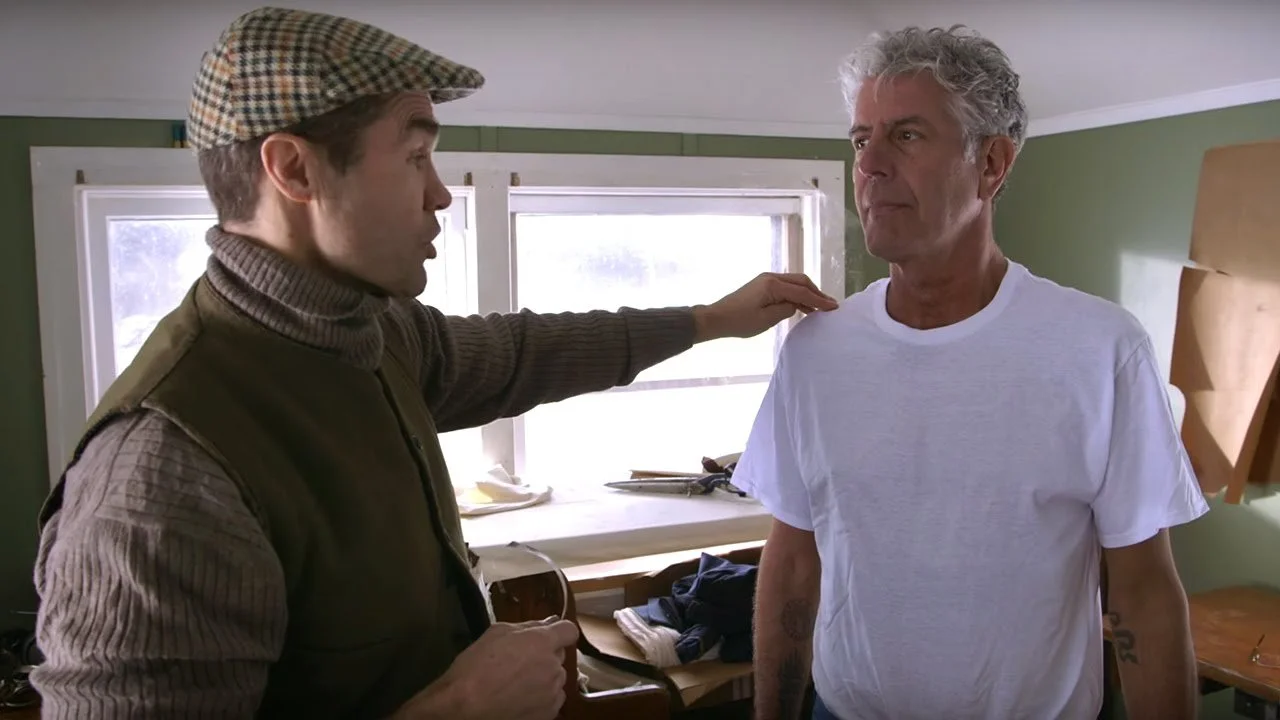
Source: Anthony Bourdain and The Balvenie’s Raw Craft Series, Episode 2 with Frank Shattuck.
3) Artisanal Craft Needs to Be Seen as a Valid Career
The four-year college path is right for many people, but we’ve deluded ourselves into thinking it’s right for everyone. All too often, students who are better suited for a trade go from high school to college by default, hoping to find their passion—only to become discouraged when they’ve been prepared solely for careers that involve sitting in front of a keyboard.
This is primarily a cultural problem driven by the false view that trades are less dignified, less lucrative, and that tradesmen are less intelligent. It’s not usually stated explicitly, but realistically, how many Northern Virginians would be equally thrilled to hear their high schooler say, “I want to apprentice with a shoemaker,” as “I want to go to Amherst College”?
We can’t simultaneously lament the decline of American manufacturing while holding this prejudice. As I’ve explained in a previous article, there is great dignity to be found in the trades.
Solution: Learn about the abundant opportunities in the trades—and parents, be open to them, particularly for your more unruly children.
4) Artisanal Craft Is Misunderstood
Consumers often think of artisanal products as the pinnacle of quality in their category. While high quality is a necessary feature, it’s really just a prerequisite for something else entirely. As I noted above, the marginal increase in quality is not proportionate to the marginal increase in cost—so much so that the comparison on paper is absurd. Even entertaining the comparison seriously indicates a misunderstanding of what artisanal goods are truly for and where they fit into our lives.
Artisanal goods are not merely an option within the market; they are something that transcends it. I would liken them to Renaissance patronage of the great artists and tradesmen we all know—Michelangelo, da Vinci, Brunelleschi, and others. Of course, supply and demand still applied, and transactions occurred. But the owner was only the most immediate beneficiary. Society itself was enriched by the creation and existence of their great works.
Renaissance Florence is remembered not for its marginal contributions to material progress, but for its enduring contributions to humanity. So too might we be remembered—if we value things like artisanal goods that represent the virtues enabling their creation: dedication, honesty, truth, and beauty.
Solution: Recognize this:
Bespoke shoes probably aren’t for you—but their prevalence can serve as a barometer for the health of a society. Do we value beauty for its own sake, or do we focus solely on utility? Do we value the eternal or only the material?
If the former, bespoke shoemakers will thrive—and more importantly, so will we as a society. If the latter, we will degenerate. The bespoke shoemaker will simply be the first to go.