
Ouch! I Hurt My Back! What to Do Immediately… and What to Do Next
You're mid-set, mid-mile, mid-way through exercise class or simply on a drive to pick up your elderly parent. Maybe it's a squat, turning the corner, twisting during yoga, or doing a basic move during Hot Pilates class. Maybe it’s even (GASP) not related to exercise! And then — there it is.
A pull. A pinch. A weird zing that definitely wasn't there thirty seconds ago. Oh, and it’s in your back!
Your first instinct is probably some version of “oh nooo!”. I’m forever injured. I need to SIT!
AND…That instant fear, left unchecked, can do almost as much damage as what is actually happening in your back.
After practicing in this field for over two decades, I've noticed that the back is the one body part people treat with such outsized fear. Tweak your left big toe and you walk it off. Tweak your back? Suddenly you're bracing for months off from training, envisioning spinal surgery.
Your back needs to receive the same measured response as any other joint or muscle upon injury. How you react, especially in the first few minutes (no matter how big or small the injury), matters more here than almost anywhere else in the body, and can determine how quickly – or slowly – you are able to recover.
How exactly should you react? Below I outline what I recommend doing immediately when you feel like you’ve hurt your back, what to do in the days after, and why I believe your nervous system can be either your best ally (or worst enemy) through the entire process.
What to Do Immediately
1. First, do not panic.
Your back has been carrying you around for decades. It's not fragile, and it almost never fails because of just one single rep or one bad moment. Hurting your back is usually the tipping point of a combination of factors that have been quietly stacking up for some time: posture that's been little off for months/years, breath-holding through effort, and movement patterns in your workout that maybe weren’t quite dialed in. The exercise or movement you were doing when you injure your back is often just the last straw, not the root cause. Adding fear only makes the experience worse, and we'll get into exactly why later below.
2. Get into an "all fours" position.
Hands and knees on the floor is one of the most supported positions your spine can be in. It takes the compressive load off your back entirely and lets the surrounding muscles stop guarding. Once there, gently practice cat-camel: slowly arch your back up toward the ceiling, then let it dip down, moving through a small, pain-free range, BREATHING through EVERY rounded and curved spinal position. This isn't about stretching, but instead just showing your nervous system that your spine can still move, safely.
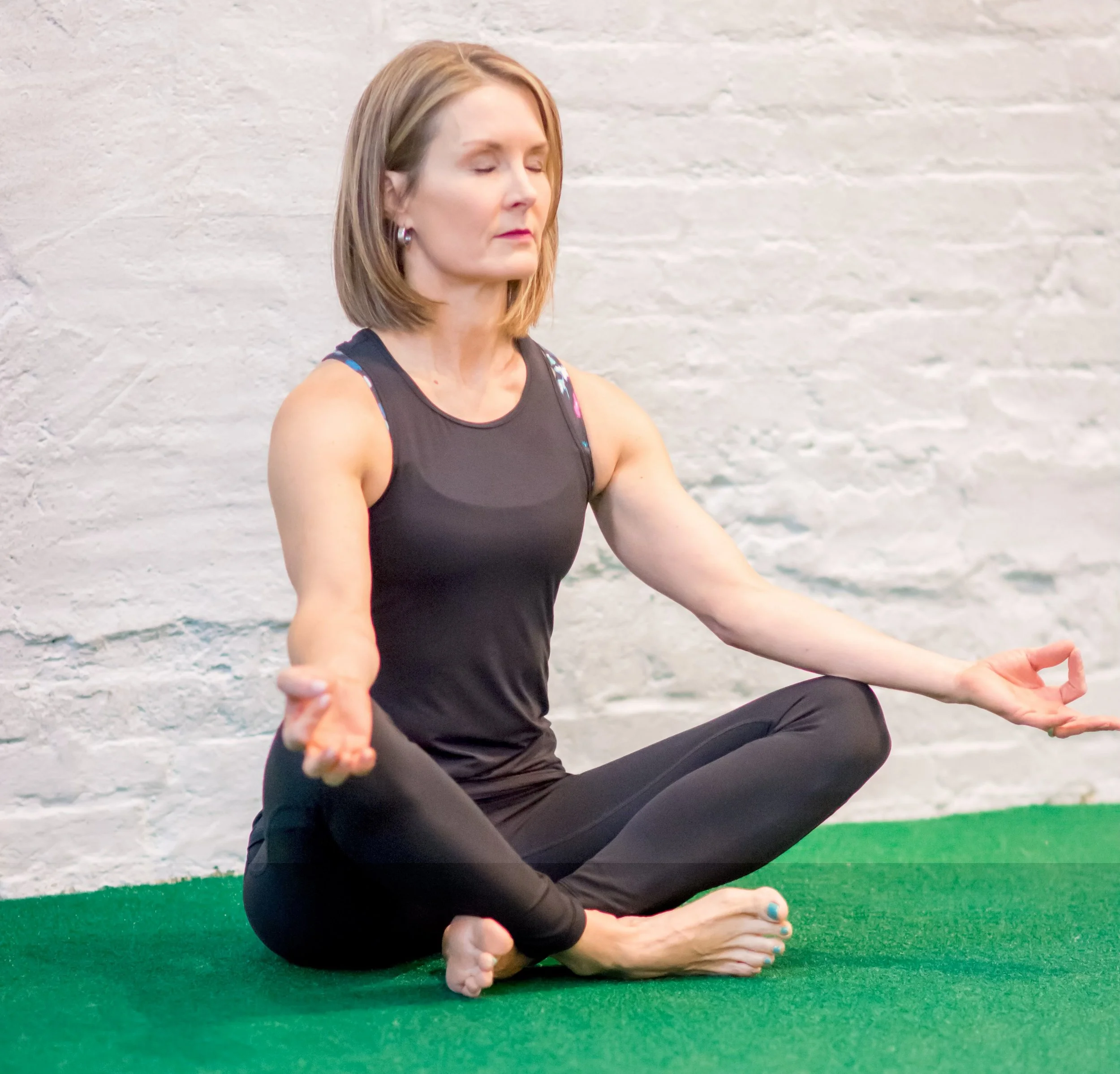
3. Breathe.
The key is slow, deliberate breaths - long exhales that are longer than the inhale - to tell your nervous system that you're safe. This sounds almost too simple to matter, but it's doing real physiological work, which we'll unpack next.
4. Do a quick, honest check-in.
Ask yourself specific questions, such as:
- Is this sharp and localized, or a dull, generalized ache?
- Does it hurt more when you're still, or only with certain movements?
- Can you still stand up straight? Can you walk or even breathe deeply?
- Is there any numbness, tingling, or weakness running down a leg?
Most of the time, what you're feeling is a muscle or fascia responding to a myriad of moves – a combination of how you stand, walk, or sit – not a structural injury. A strained muscle is uncomfortable, even alarming, but it is not the same thing as a herniated disc or a fracture.

Why "Don't Panic" Is More Than a Platitude
Pain is often not a smoke alarm, meaning it’s not something that goes off only when there's fire. Pain is an entire series of outputs your brain generates based on a mix of signals from your body and how threatened your brain perceives you to be.
This loop is called central sensitization, and it's not "in your head," but a real, measurable physiological process. It’s your nervous system genuinely turning up the volume on pain signals when it believes you're under threat.
Here’s all the things that might actually be happening when you sense pain:
1. You feel a twinge.
2. Your brain interprets it as a threat ("something is wrong, this could be serious").
3. Your sympathetic nervous system—the fight-or-flight system—switches on.
4. Muscles around the area tighten defensively, blood flow patterns shift, and your pain-signaling threshold drops.
5. Because your nervous system is now more sensitive, the same physical input feels like “more” pain.
6. “More” pain creates the fear that something is seriously wrong.
7. Repeat, repeat, repeat.
Fear isn't just an emotional reaction to pain. It can actively amplify the pain itself, making a back discomfort more dangerous, and more painful!
And while I know “don’t panic” might be easier said than done, you must consider how your brain is reacting to what your body is feeling. Understanding the output loop that you actually experience will help you remain a bit more calm, thus allowing you to better manage your pain.
What to Do Next (In the Days After)
Once the acute moment has passed, recovery is about staying active without provoking things:
1. Keep moving, gently.
Short walks and pain-free range-of-motion work—like continued cat-camel—keep blood flow going and prevent the stiffness that comes from total rest.
2. Address the whole chain, not just the sore spot.
If you know you've got a tight hip or a weak glute, this is the moment to start paying attention to it, in addition to caring for the painful area. Fix your posture!
3. Reintroduce load gradually.
Don't jump back into your previous training intensity in one step. Build back up over days, not hours. We are training your nervous system, and it needs time to “regroup”.
4. Watch how you're thinking about it.
If you notice yourself bracing, guarding, or catastrophizing every time you move, then it might be worth addressing directly.
When to Actually Be Concerned
Calm certainly doesn't mean careless. Get evaluated if you feel any of these symptoms:
- Numbness, tingling, or weakness radiating down one or both legs
- Loss of bladder or bowel control (seek emergency care immediately)
- Pain following a fall or high-impact trauma
- Pain that's severe, unrelenting, and not improving with rest over several days
- Fever alongside back pain
If none of those apply, you're likely dealing with a strain, muscle guarding, or your body simply asking for a modified movement pattern next time.
Resist the urge to jump straight to the surgeon.
When something in your back flares up, it's tempting to want the most serious-sounding expert on the phone right away. But surgery is designed for a small slice of back problems—structural issues that aren't responding to anything else—and the overwhelming majority of exercise-related back pain never gets anywhere near that category.
Reaching for the most drastic option first usually just adds more fear into a system that's already on high alert, which, as we covered above, tends to make things feel worse, not better.
What actually helps first is getting eyes and hands on the tissue itself. This is where having a soft tissue specialist such as a physical therapist, chiropractor, or massage therapist you already know and trust, makes a real difference. They can assess whether this is muscular guarding, a fascia issue, or something that genuinely warrants further imaging, and they can start treatment immediately instead of you waiting weeks for a specialist referral that, most of the time, you won't end up needing.
This is especially true if you're over 45 and exercise regularly. By this stage, most of us are carrying some combination of old compensations, tighter tissue, and a kinetic chain that's been quietly adapting for years.
A soft tissue specialist who already knows your history and your movement patterns can spot the difference between "this is your normal pattern acting up" and "this is genuinely new," far faster than a first-time visit with any other provider. Having that relationship in place before something flares up means you're not scrambling to find someone while you're anxious and in pain.

Think Confidently; Recover Safely
Since fear escalates the physical experience, deliberately calming your nervous system is not a soft, feel-good suggestion that only applies when the injury first happens: it's also a functional part of longer-term recovery. This is the reason your nervous system is your most trusted ally to a smooth comeback when you injure your back.
As you recover from a back injury, keep these things in mind:
1. Remember your slow breathing
It’s not only applicable immediately when you injure your back, but anytime you feel nervous about pain and movement. Long exhales (longer than your inhale) signal safety to your nervous system. Try four seconds in, six to eight seconds out.
2. Change your self-talk.
Swap the "something is broken" mentality for "my back is telling me it needs a break, and that's normal." Most exercise-related back sensations are muscular, not structural, so the key is going for accuracy, not denial.
3. Keep moving – gently.
Once the acute moment passes, total stillness for days can actually prolong sensitivity. Gentle motions like walking or stretching slowly signals to your nervous system that the area is safe to use and can contribute towards recovery.
4. Avoid Dr. Google spirals.
We’ve all been there, but I have to remind you: Searching online for your symptoms while anxious almost always surfaces the scariest possible explanation first, and this feeds right back into the fear loop.
Your Back Doesn't Work Alone
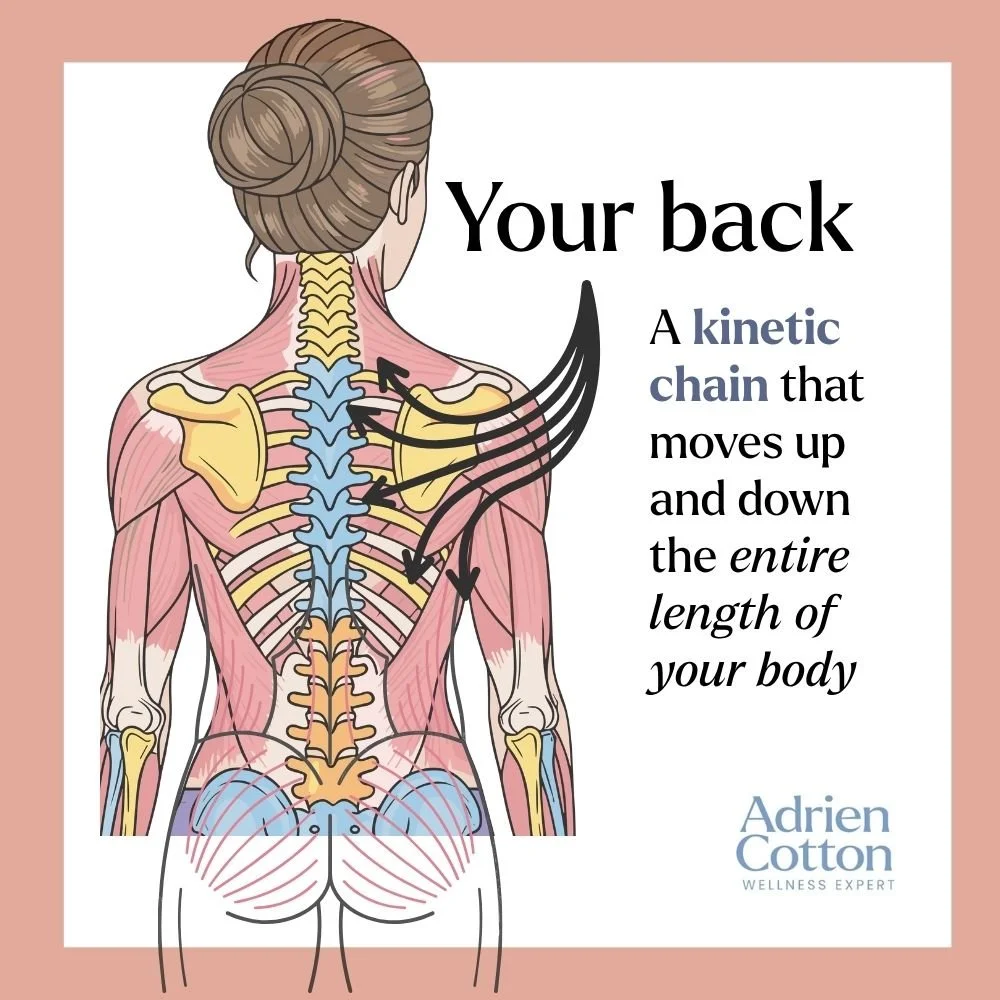
What surprises many people is that the back is rarely the actual root of the problem. It's part of your body's kinetic chain – an interconnected system of joints and muscles that all influence one another.
A tight hip, a weak core, even an old, "forgotten" ankle sprain (yes, alllll the way down there, so far from your back!) can all quietly change how force travels through your body, and your back often ends up absorbing the consequences.
Have a cranky knee you've been favoring for months? There’s a fault line running through your entire kinetic chain, and your back may simply be the place it finally showed up. This is why chasing only your back pain is often missing the real story.
Which brings us to an unsung hero: your glutes are your back's insurance policy. Strong, well-firing glutes absorb load, stabilize your pelvis, and take enormous pressure off your lower back with every step, squat, and lift.
When the glutes go quiet (which happens easily with a lot of sitting) the lower back picks up the slack it was never designed to carry alone. If you want to protect your back long-term, strengthening your glutes is one of the highest-leverage things you can do.
Strong Foundations
Building that resilient foundation—starting with strong glutes and a balanced kinetic chain—is central to so much of what I practice and teach to my community, to help support our bodies for life. Feeling a twinge in your back during exercise is not uncommon, and for most people, also not dangerous.
What determines whether it turns into a fleeting inconvenience or a weeks-long ordeal often has a lot less to do with the initial tweak and more to do with what your nervous system does following the injury.
No matter what, remember: Stay calm, assess honestly, move gently, and give your body the benefit of the doubt. You, and your back, are more resilient than your fear wants you to believe.
If you are ready to put this into practice (and protect your back!), check out my YouTube channel for my ‘Movement Basics’ series – four collections of fundamental exercises that train your strength and stability. This video in the series, in particular, incorporates a lot of lower body, core, and back exercises for simple, movement-inspired basics you can start today.