
The Hidden Work of Feeding Ourselves
What we eat can be stressful enough on its own. Enough protein. Plants. Calories. Ingredients. Organic or not. “Will it make me fat?” What everyone on Instagram seems to be eating. Am I eating enough? Too much? The “right” things?
But today I want to talk about something we rarely acknowledge: all of the work that happens between deciding what we want to eat and sitting down to eat.
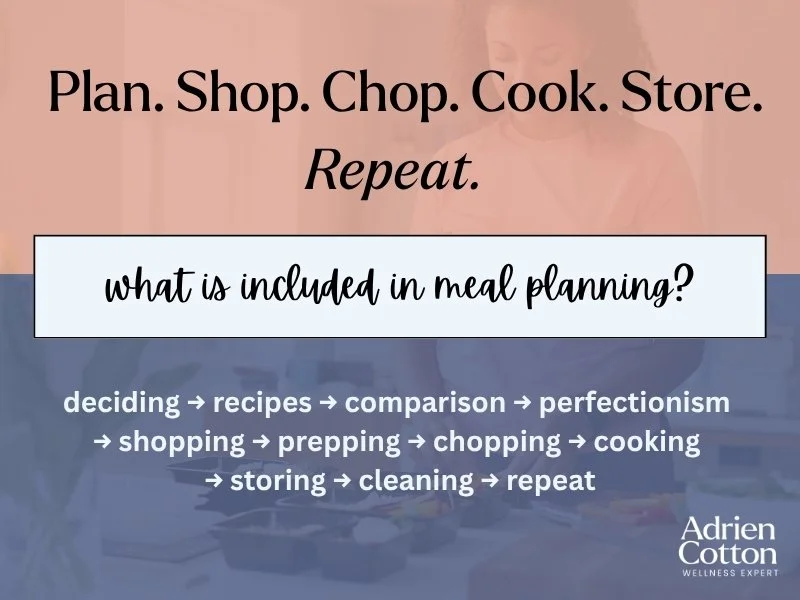
There’s the planning. Finding recipes. Checking the calendar. Making the list. Shopping. Unloading. Chopping. Cooking. Portioning. Storing. Cleaning.
And then somehow doing it all over again.
Layered on top of all of that is comparison: Should I be meal prepping on Sundays? Should my refrigerator look like hers? Why does everyone else seem to have this figured out?
How many times has a friend told you about a great meal they had, then shares the recipe? Whoa! 100 times? But, that’s the easy part. Now, the execution, making it palatable to all mouths it will feed, and scheduling MUST take place.
No wonder the words “meal planning” can make us want to give up before we’ve even started.
What is a good “meal plan” for you?
For some, meal planning is a Sunday ritual of chopping vegetables and stacking containers in the fridge. For others, it's a shared family note on your phone that says, “Chicken... Tuesday? Maybe?” And for others, it might mean checking the menu before your business dinner Tuesday and knowing what you’ll order to fuel yourself well.
And for a lot of the people who come to me for help, it's simply the “thing” they know they should be doing but somehow never quite get around to.
Why?
We confuse successful meal planning with perfect meal planning.
AND
We fail to acknowledge that meal planning involves a number of steps that can feel overwhelming—even daunting.
Meal planning, at its core, is simply deciding what you're going to eat before you eat.
That's it.
Everything else – the recipe choosing, the grocery list, the containers, the chopping and prepping, the color-coded labels - is execution.
Prepping, batch cooking and portioning everything into those containers we fantasize we’ll use (and often don’t!) are simply methods. We can choose them. We can change them. They are not the definition of meal planning.
I raise this because I know so many women get stuck when they hear the words “meal planning.” Suddenly, visions of Pinterest and perfection rise in their minds. And then any planning around how they’ll fuel themselves goes out the window altogether, and we default to the daily scramble.
Pinterest, Instagram and social media are designed to grab our attention—and often to show us the PERFECT way of doing just about anything.
Instead, what if we shook loose the perfection goal?
What if the goal was simply to build a plan that works for me?
Not my friend. Not my colleague. Not the woman on Instagram. Not Pinterest.
Me. My life. My week.
The theme in our community recently has been “taking back your power.” This is one way to ease the stress of comparison syndrome. Choose for you!
And an aside for those of you who train hard three to five times a week: if you are putting that much effort into your training, but giving almost no thought to how you’ll fuel yourself, we have a disconnect.
Your body needs ample protein, carbohydrates and fats to recover, build muscle and adapt to the work you're asking it to do.
Back to meal planning.
My suggestion is never to overhaul your entire pantry or hand yourself a rigid week of meals to follow.
Before any execution, start with something we use across all the spokes of my Wellness Wheel but often fail to recognize as an essential wellness tool:
Your calendar.
If it's on the calendar, it's far more likely to happen. If it's not...you get it.
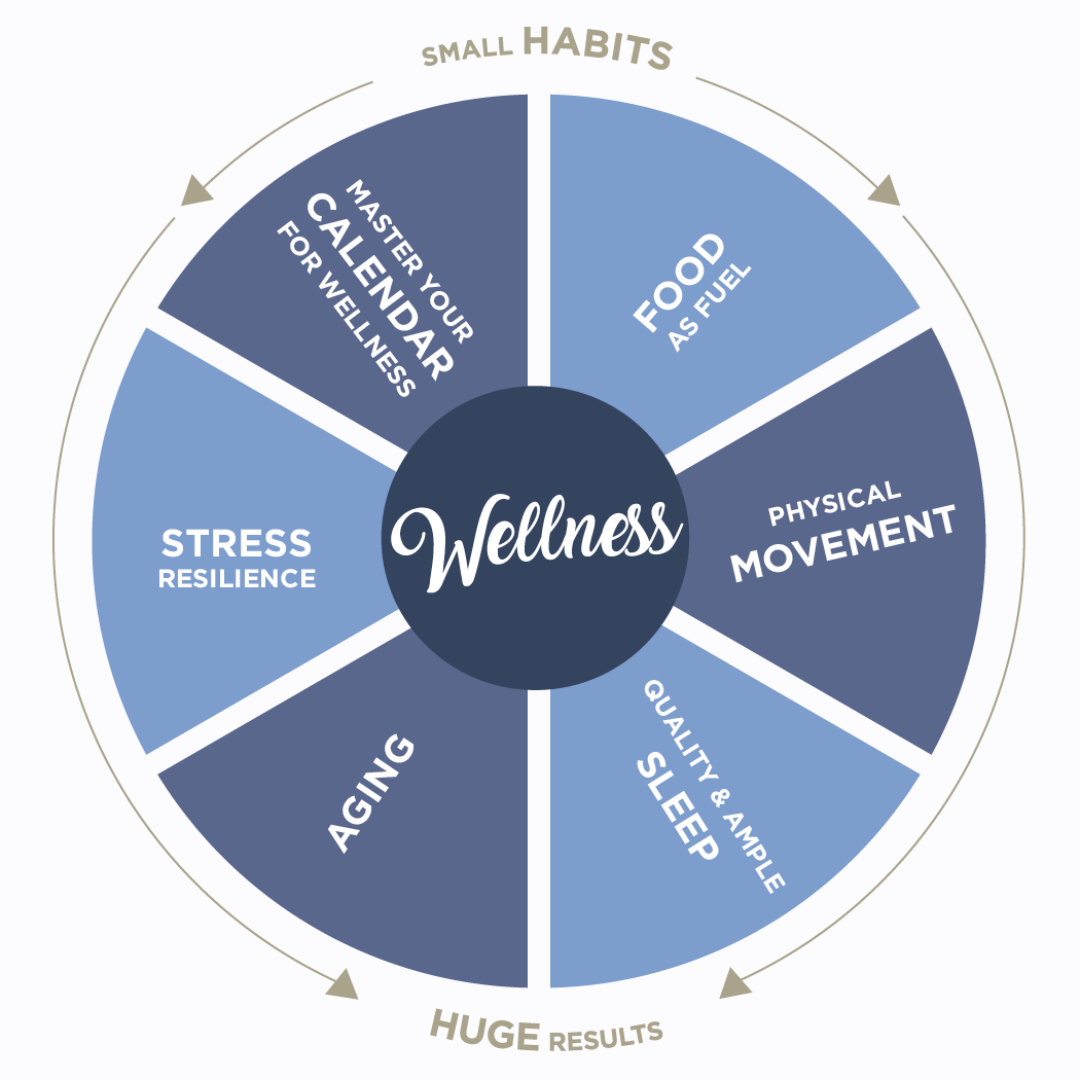
Putting meal planning on the calendar automatically begins to calm the stress of “I don't have time to meal plan.”
Planning is deciding. Execution is doing.
Now we can separate two very different things:
Planning: What does my week look like? What nights am I home? What will I eat? What do I need? How long will each meal take to prepare and clean (one pot versus 10?)
Execution: Shopping. Ordering. Chopping. Cooking. Packing. Storing.
That distinction matters because it removes the idea that “meal planning” means spending four hours on Sunday with 17 perfectly organized glass containers.
Meals themselves are already non-negotiable you know you have to eat. It's the “thinking ahead” that keeps getting squeezed out, often because of frustration, unrealistic expectations and comparison syndrome.
When we separate planning from execution, meal planning becomes much easier: an honest look at the week ahead and a few decisions about what you're going to eat and when.
And for some of you, this may be exactly where you start.
Even McDonald’s can be part of your meal plan!
Seriously.
Planning doesn't mean every meal has to be homemade, organic, perfectly portioned or Instagram-worthy. It means you made the decision ahead of time rather than waiting until you were starting, exhausted and out of ideas.
The planning itself can take just 15 to 20 minutes once a week.
Execution - the shopping, chopping, cooking, packing, prepping, ordering or whatever that means for your life—takes as long as it takes.
And execution deserves space on your calendar too. Execution is often longer than the planning yet many don’t make this distinction and end up frustrated with the amount of time it can take to prepare one to four meals per day.
Plus that way, you're doing it with the right mindset and on your own terms—not scrambling to invent dinner from nothing at 6 PM, tired and irritated, scrolling recipe apps or giving up and ordering takeout again.
If you began treating meal planning as a non-negotiable self-care appointment rather than something to squeeze in, I believe it can change everything.
Which brings me to the real answer to the question: *What really is meal planning?*
It’s never all about food. It's about scheduling.
I always say: “if it's not on your calendar, it's probably not going to happen.”
And the people who successfully meal plan aren't necessarily better cooks or more disciplined than the rest of us.
They've simply decided that part of their week is a fixed appointment to plan how they're going to feed themselves - rather than hoping that every day, somehow, a meal will appear that makes them feel as good as they want to feel.
So if you want to master meal planning, here's where I'd start:
Put it on the calendar first. Pick one day, one recurring 15-minute window, and treat it like any other appointment you wouldn't cancel. It can be choosing recipes day.
Plan the week, not the pantry. Before you think about recipes, look at what's actually happening - late meetings, kids' practices, travel - so your plan matches your *real* week, not your ideal one.
Keep a rotation of “go to” meals you could cook blindfolded. You don't need 21 new recipes every week. A handful of go-to, protein-forward meals you can make on autopilot removes decision fatigue from many nights. We have an Adrien Cotton recipe book that rocks. No need to be Julie Childs or re-create the wheel!
Build in seated, no-distraction meals. Aim for at least two or three nights a week when you actually sit and eat *without multitasking*. The point isn't another rule to follow; it's creating enough space to actually experience the meal you're eating. Bonus: Share it with a loved one to get a boost of Oxytocin!
Let it be imperfect. A plan that gets adjusted midweek because life happened is still a plan. The goal isn't perfection. It's making some good decisions ahead of time instead of making all of them in a moment of hunger and exhaustion.
The hidden work of feeding ourselves is real. We can't eliminate all of it. But we can stop making it harder by expecting ourselves to do it perfectly.
Put the planning on the calendar. Make it fit the week you actually have. Keep the food simple. Repeat what works. Change what doesn't.
Feeding yourself well doesn't require perfection. It requires a little thinking ahead—and permission to make it easier.
If you want a head start, grab my recipe collection — 60 tried-and-true recipes I've tested on my own family, on my own busy schedule.
And if you're ready to go deeper into what's really happening in your body *and* your calendar during this stage of life, get on the waitlist for Master Menopause NOW!, my signature program relaunching September 1. It’s a fully online, self-paced course that helps unpack and examine how you can develop the right habits to feel stronger where you are in your life.